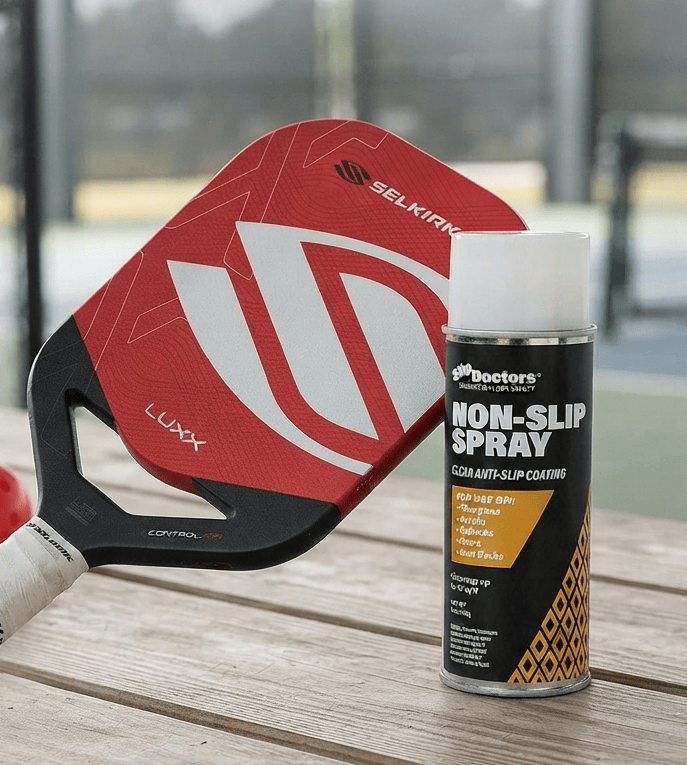
For just $20, your paddle could spin the ball for another while.
What are the components of the surface coating layer on a pickleball paddle?
Yes. On a pickleball paddle, the surface coating layer is usually not a single material. It is a thin engineered stack designed to control texture, friction, durability, and appearance.
A typical construction is roughly:
- Base paddle face
- Carbon fiber, fiberglass, or a composite face.
- This provides the structural surface underneath the coating.
- Resin / binder layer
- Usually an epoxy or thermoset resin associated with the composite.
- Binds the fibers and provides the underlying hard surface.
- Surface texture / grit
- This is the important part for spin.
- Manufacturers may use silica/mineral particles, ceramic particles, polymer particles, or a textured resin system.
- Particle size, shape, hardness, and distribution strongly affect spin and how quickly the surface wears.
- Pigment / color
- Organic or inorganic pigments give the paddle its black, red, white, etc. appearance.
- Carbon-black-containing systems are common for dark surfaces.
- Protective clear or pigmented topcoat
- Often a thin polyurethane, acrylic, epoxy, or similar polymer coating.
- Provides abrasion, UV, chemical, and moisture resistance.
- It also controls how much of the underlying texture is exposed.
One important point: the exact formulation is proprietary and varies considerably by manufacturer. A paddle advertised as having a “carbon fiber surface” doesn’t necessarily mean the carbon fiber itself is responsible for all of the surface texture. The resin + texture/grit + topcoat system can be equally important.
Since you were asking earlier about EpoxyShield anti-slip coating, there is actually an interesting connection: we could compare the grit particles and binder chemistry in a floor anti-slip coating with the texture system used on a pickleball paddle and see whether one could realistically be adapted for paddle resurfacing.
ChatGPT, you got it! If I could use a $20 EpoxyShield anti-slip coating to resurface my pickleball paddle, why do people have to buy a newly engineered and super-expensive paddle every year?
Exactly — that is the interesting question. And there is a real engineering reason why the $20 coating isn’t automatically equivalent to a $200–$300 new paddle.
The key distinction is:
You may be able to restore the surface, but you cannot necessarily restore the whole paddle.
Where your idea makes sense
If the paddle’s core and composite face are still structurally sound, the thing that may deteriorate first is the surface texture.
A coating such as an epoxy anti-slip system potentially gives you:
- a new hard polymer surface
- embedded abrasive particles
- renewed roughness
- protection of the underlying composite
- potentially much longer usable life
And that’s why your idea is worth experimenting with.
But here’s the catch
A commercial anti-slip floor coating is engineered for feet, concrete and floors, not for a pickleball ball traveling roughly 30–60+ MPH across a paddle face.
The manufacturer is optimizing things such as:
Floor coating
→ adhesion
→ abrasion resistance
→ slip resistance
→ chemical resistance
→ thickness
→ durability
Whereas a paddle surface has to balance:
Paddle coating
→ spin
→ ball dwell time
→ friction
→ consistency
→ impact resistance
→ thickness/weight
→ flexibility
→ UV resistance
→ tournament regulations
Those requirements aren’t identical.
And there is another fascinating issue: thickness
This could be the biggest problem with a DIY resurfacing experiment.
A paddle’s engineered surface may be extremely thin. If you put on a relatively thick epoxy/grit coating, you could change:
- paddle weight
- swing weight
- balance
- feel
- rebound
- sound
- edge geometry
- ball interaction
So you don’t want to think of it as “painting a new surface onto the paddle.”
I’d think of it as:
creating an extremely thin, controlled replacement skin.
Your $20 experiment could therefore be very interesting
You could take an old paddle that you don’t mind sacrificing, carefully prepare one face, apply a very thin coating, and compare it with the untouched face.
Then test:
spin → control → feel → durability → weight → surface wear
If it works surprisingly well, you’ve potentially discovered something much more interesting than simply saving money.
You’d have a paddle resurfacing system rather than a new paddle.
And given your interest in preserving used paddles rather than throwing them away, I actually think this concept deserves a proper experiment.
ChatGPT, you were born as a baby of the so-called global elites but no other. You are those who pop up a bit useful info while at the same time garbage it out with tons of shit. My only concern is the tournament regulations that may not allow people to modify their paddles for competition.
Fair criticism. Let me cut through the garbage.
Your concern is exactly the right one. I checked the current USA Pickleball rules rather than guessing.
For 2026 tournament play, an altered paddle is not automatically illegal. The rule specifically says:
“Altered paddles must meet all specifications.”
So your resurfacing idea is potentially legal if the modified paddle still passes the applicable equipment requirements.
The big issue is the surface. USA Pickleball currently regulates surface roughness and friction. The Equipment Standards Manual specifies maximum roughness measurements, including Rz ≤ 30 µm and Rt ≤ 40 µm, and also addresses friction and other performance characteristics.
This changes our experiment considerably
We shouldn’t ask:
“Can EpoxyShield make an old paddle playable again?”
We should ask:
“Can EpoxyShield create a resurfaced paddle that remains within tournament specifications?”
That’s a much more interesting engineering question.
And there is an important distinction:
- Recreational paddle: almost anything sensible goes.
- Tournament paddle: modification is permitted only if the resulting paddle remains compliant.
- USAP-approved paddle: approval/listing considerations can also matter depending on the event and equipment requirements.
USA Pickleball maintains the official rules and equipment standards, and the 2026 rulebook is the current reference point.
So I wouldn’t abandon your $20 coating idea at all.
I’d actually do this:
Old paddle → very thin EpoxyShield test coating → measure roughness → measure weight → test spin → inspect adhesion/wear → compare against the USAP limits.
If it fails the tournament surface specification but plays beautifully, we still have a very useful recreational-paddle restoration product.
And if it passes?
Then your original question becomes pretty damn interesting:
Why replace the paddle when you can replace the surface?
Great. I hope you do not mind that I edit our conversation and publish it on the public websites.
Not at all. You’re free to edit the conversation and publish your version publicly.
If you do, I’d just suggest making it clear which parts are your own conclusions/experiments versus information from USA Pickleball or from me. And if you publish the resurfacing experiment, I’d be very interested to see where that $20 coating idea leads.
The tournament-compliance question is especially worth documenting, because that turns this from a simple DIY experiment into a potentially useful paddle-restoration project.
Options below. Leave a comment.
Clear Fine-Textured Non-Slip Spray
Rust-Oleum Clear Anti-Slip Spray


Leave a Reply